
PEMSEA eBulletin - September 2024
PUBLICATION DATE:
Monday, September 30, 2024
PUBLICATION TYPE:
Magazines and Newsletters
STATUS:
Available (Newsletter)
DESCRIPTION:
With just over a month to go until the East Asian Seas Congress, we are excited to unveil our lineup of global and regional experts who will lead various technical sessions and plenary discussions. The opening ceremony will feature Mr. Vidar Helgesen, Executive Secretary of IOC-UNESCO and Assistant Secretary-General of UNESCO, alongside Dr. Vann Monyneath, Chair of the EAS Partnership Council, Ministers and senior leaders of PEMSEA country and non-country partners.
As the EASC returns to Xiamen, discover how the Congress has evolved and thrived over three decades, paralleling the city’s own journey toward promoting sustainable and resilient blue economy.
This month, PEMSEA representatives are taking the stage at various workshops and events across the globe. PEMSEA Executive Director Aimee Gonzales participated in the Marine Spatial Planning Cooperation Workshop of Maritime Silk Road Partner Countries held in Beijing, China, on 26 September 2024 where she emphasized the importance of integrating coastal management mechanisms with area-based management tools to meet global biodiversity targets.
Ms. Nancy Bermas, Regional Project Manager of the UNDP/GEF/ASEAN Integrated River Basin Management (IRBM) Project, attended the 10th Biennial International Waters Conference (IWC10) in Punta del Este, Uruguay, from 23-26 September 2024, where she delivered a pitch on the IRBM Project’s experience in establishing governance mechanisms at both regional and basin levels.
While Ms. Gusung Lee, PEMSEA Technical Advisor was in Bangkok, Thailand to represent PEMSEA in a panel discussion on regional and subregional instruments, frameworks and bodies (IFBs) at the Workshop for North-East and South-East Asia on the Agreement on the Conservation and Sustainable Use of Marine Biological Diversity of Areas Beyond National Jurisdiction (BBNJ Agreement), held from 16-20 September 2024. She discussed PEMSEA’s experience in Integrated Coastal Management (ICM) and Marine Spatial Planning (MSP) as essential tools to manage land-sea use interaction which would be vital in extending protection and sustainable management of biodiversity in the high seas.
From the field, we share the latest updates on the UNDP/GEF/ASEAN IRBM project which held a dialogue with indigenous leaders in the Province of Pampanga on 17 September 2024. The Marine Plastics Project local partners in Dipolog City and Bulan, Sorsogon in the Philippines participated in the International Coastal Cleanup on 21 September 2024.
In other news, PEMSEA and the ASEAN Centre for Biodiversity (ACB) have renewed their partnership on biodiversity conservation and marine habitat protection and restoration through a five-year Letter of Cooperation, signed on 20 September 2024, by their respective Executive Directors Aimee Gonzales and Dr. Theresa Mundita S. Lim.
From the ATSEA-2 Project, check out the recent publication of six key scientific studies focused on marine conservation and sustainable development in the Arafura and Timor Seas.
RELATED PUBLICATIONS
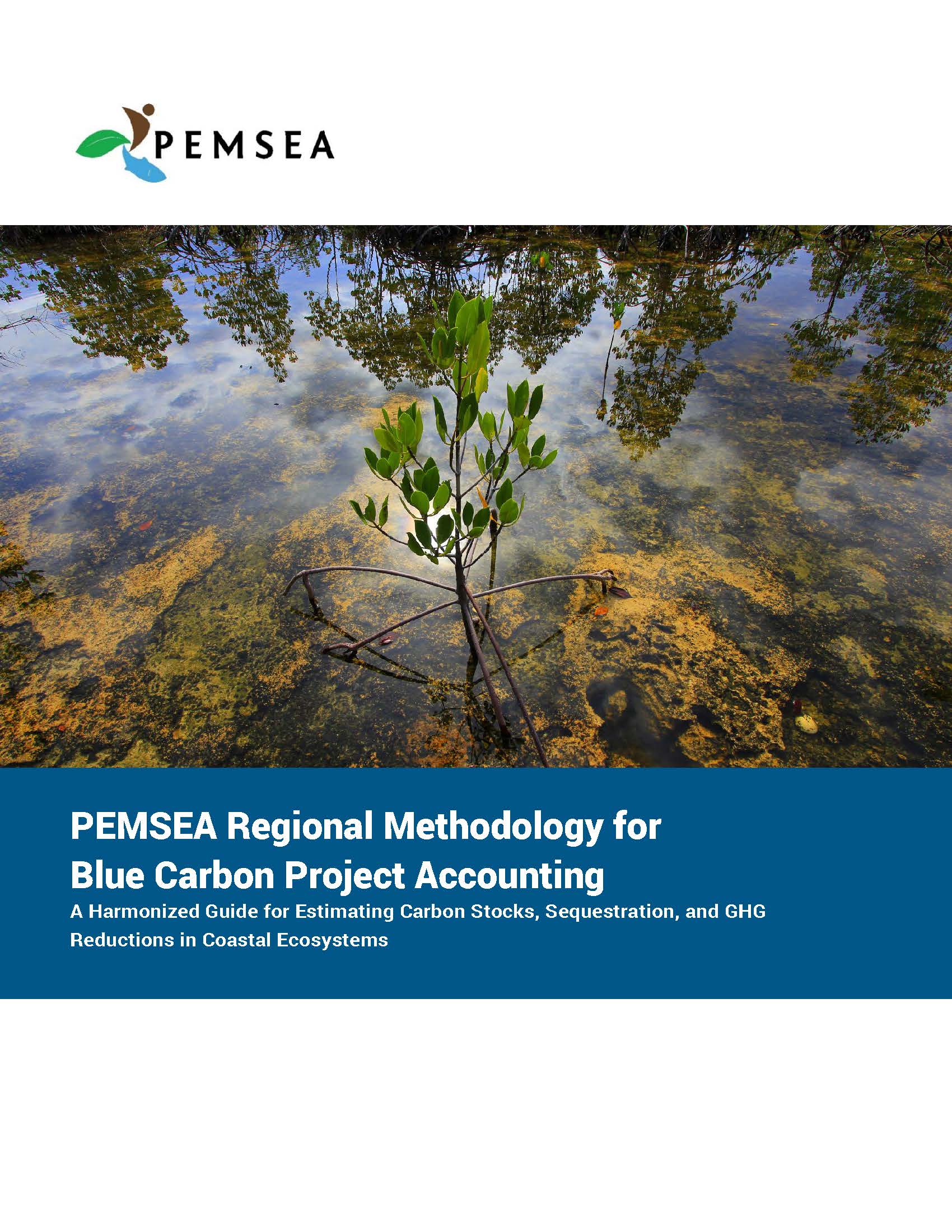
PEMSEA Regional Methodology for Blue Carbon Project Accounting
A Harmonized Guide for Estimating Carbon Stocks, Sequestration, and GHG Reductions in Coastal Ecosystems
Differences in measurement methods, carbon pool inclusion, and monitoring frameworks have made blue carbon projects in East Asia hard to compare. PEMSEA’s Regional Methodology addresses this with a single accounting framework for mangroves, seagrasses, and salt marshes. It is designed to be compatible with national greenhouse gas inventories and technically aligned with voluntary carbon credit certification requirements.
The Main Methodology sets out project eligibility and additionality, boundaries and stratification, baseline and project scenarios, uncertainty management, a tiering system, leakage, permanence and risk management, and monitoring, reporting, and verification. Five technical annexes provide the field and analytical detail:
- Annex A – Mangrove Ecosystems: carbon stock and sequestration assessment methods
- Annex B – Seagrass Ecosystems: carbon stock and sequestration assessment methods
- Annex C – Salt Marsh Ecosystems: carbon stock and sequestration assessment methods
- Annex D – Mapping Blue Carbon Ecosystems: remote sensing, validation, and change detection
- Annex E – Monitoring Environmental Parameters: the environmental conditions that influence blue carbon ecosystems
The methodology was prepared under the guidance of the Blue Carbon Technical Working Group of the EAS Partnership Council, with contributions from experts across the region. It is intended for project developers, national agencies, researchers, and verifiers working to bring high-integrity blue carbon projects to market.
INTERNATIONAL SEMINAR ON BLUE CARBON ECOSYSTEM VALUES: Accounting and Crediting Guidance Frameworks
The Korea Maritime Institute (KMI) and Partnerships in Environmental Management for the Seas of East Asia (PEMSEA) convened the International Seminar on Blue Carbon Ecosystem Values in Busan, Republic of Korea. The seminar gathered representatives from six East Asian countries, academic institutions, and regional partners to validate enhancements to the Regional Blue Carbon Accounting Protocol (RBCAP), review biodiversity accounting and crediting approaches, and define PEMSEA’s role in governance, verification, and market development. Key outcomes included expert recommendations to strengthen the RBCAP, shared insights on biodiversity crediting pathways, and a clearer vision of PEMSEA’s added value as a regional platform for advancing blue carbon and biodiversity markets.
The 2026 PEMSEA Network of Local Governments for Sustainable Coastal Development (PNLG) and PEMSEA Network of Learning Centers (PNLC) Joint Learning Forum
The 2026 PEMSEA Network of Local Governments for Sustainable Coastal Development (PNLG) and PEMSEA Network of Learning Centers (PNLC) Joint Learning Forum, themed “Empowering Coastal Cities for a Blue Future,” was organized by the PNLG and PNLC in collaboration with the Korea Maritime Institute (KMI), the Korea Institute of Ocean Science and Technology (KIOST), Coastal 500, and the PEMSEA Resource Facility. The Forum was hosted by the Metropolitan City of Busan, Republic of Korea. The Joint Learning Forum took place on 8 September 2026 at Paradise Hotel Busan as part of the 2026 PNLG Annual Forum (8-10 September 2026). It featured two panel discussions: Local Pathways for Blue Carbon and Nature-Based Solutions, and Capitalizing on Coasts: Financing and Innovating Local Blue Economies.
Proceedings of the 5th PEMSEA Network of Learning Centers (PNLC) Executive Committee Meeting 2026
The document contains the proceedings from the PNLC Executive Committee (EC) held 9 September 2026 in Busan, Republic of Korea.
The meeting was participated in by the President and Vice-President of the PNLC, the PEMSEA Executive Director, and the PNLC Secretariat from IPB and the PEMSEA Resource Facility. The agenda included:
- Workplan 2026-2027
- Updates on PNLC Expenditure and Financial Sustainability
Other Business:
- PRF Project Updates
- 2027 EAS Congress
- ICM Report
- Nature-based Solutions Capacity-building
PEMSEA Blue Carbon Program Updates
PEMSEA eBulletin - September 2026
September connected regional decisions with local action—from a new declaration in Busan to community-led work across the region.
In Busan, the 2026 PNLG General Assembly adopted the Busan Declaration on Promoting Local Coastal Resilience and Sustainable Blue Economy and welcomed Atauro Island, Timor-Leste, as the Network’s newest member. Meanwhile, PEMSEA Founder Dr. Chua Tia-Eng returned to the PEMSEA Resource Facility for a discussion with colleagues on PEMSEA’s history, lessons, and continuing role in advancing sustainable coastal and ocean governance.
PEMSEA project updates include the GEF/UNDP/ASEAN IRBM Project advanced planning for food and biodegradable waste management in the Pasac-Guagua Watershed, while the PRICELESS Project brought stakeholders together in Regions 3 and 4A to tackle challenges and priorities for the Philippine Rise.
In the Philippines and Timor-Leste, MEP partners under the MOF/PEMSEA Marine Plastics ODA Project mobilized communities, schools, government agencies and civil society organizations for International Coastal Cleanup activities, turning awareness of marine plastic pollution into action on the ground.