
PEMSEA eBulletin - September 2026
September connected regional decisions with local action—from a new declaration in Busan to community-led work across the region.
In Busan, the 2026 PNLG General Assembly adopted the Busan Declaration on Promoting Local Coastal Resilience and Sustainable Blue Economy and welcomed Atauro Island, Timor-Leste, as the Network’s newest member. Meanwhile, PEMSEA Founder Dr. Chua Tia-Eng returned to the PEMSEA Resource Facility for a discussion with colleagues on PEMSEA’s history, lessons, and continuing role in advancing sustainable coastal and ocean governance.
PEMSEA project updates include the GEF/UNDP/ASEAN IRBM Project advanced planning for food and biodegradable waste management in the Pasac-Guagua Watershed, while the PRICELESS Project brought stakeholders together in Regions 3 and 4A to tackle challenges and priorities for the Philippine Rise.
In the Philippines and Timor-Leste, MEP partners under the MOF/PEMSEA Marine Plastics ODA Project mobilized communities, schools, government agencies and civil society organizations for International Coastal Cleanup activities, turning awareness of marine plastic pollution into action on the ground.
PEMSEA eBulletin - August 2026
In the Philippines, multi-sectoral stakeholders in Bicol and Cagayan Valley provided inputs for the local implementation of the PRICELESS Project and the management of the Philippine Rise Marine Resource Reserve (PRMRR). At the 4th ASEAN Blue Economy Forum, PEMSEA called for concrete investments to address the triple planetary crisis while protecting marine biodiversity and coastal livelihoods.
In Busan, the upcoming 2026 PNLG–PNLC Joint Learning Forum Technical Session will examine nature-based, network-driven pathways for local blue economies, including approaches to coastal resilience and sustainable economic opportunities from marine and coastal ecosystems.
Meanwhile, the GEF/UNDP/ASEAN IRBM Project brought together representatives from six ASEAN Member States for a regional workshop on environmental monitoring and reporting in support of IRBM program development and implementation. Participants also visited sites in the Ciliwung River Basin to examine practical applications of environmental monitoring, including industrial wastewater treatment and the Online Realtime Waste Water Quality Monitoring System (SPARING).
PEMSEA eBulletin - July 2026
Across the region, PEMSEA partners came together to reflect on progress, strengthen partnerships, and chart the path forward for a resilient East Asian Seas region. At the center of these conversations was the 18th East Asian Seas Partnership Council Meeting in Singapore, where PEMSEA Country and Non-Country Partners reviewed key achievements, agreed on strategic priorities, and reaffirmed a shared vision for healthy coasts, resilient communities, and sustainable blue economies. The field visit to Singapore’s Sungei Buloh Wetland Reserve offered participants an opportunity to see firsthand how conservation efforts and nature-based solutions contribute to resilient coastal ecosystems.
Collaboration extended well beyond the EAS Partnership Council Meeting. This month saw the approval of revised pilot projects in three Philippine sites and continued preparations for implementation in Timor-Leste under the MOF/PEMSEA Marine Plastics ODA Project, bringing local governments one step closer to turning plans into action. The GEF/UNDP/ASEAN Integrated River Basin Management (IRBM) Project also marked several milestones, convening regional dialogues on river basin governance, holding its 4th Regional Steering Committee Meeting, and advancing pilot project development through field missions and local engagement.
Taken together, these stories reflect a busy July and show how regional cooperation is translated into practical solutions—through partnerships, informed decision-making, and sustained action on the ground.
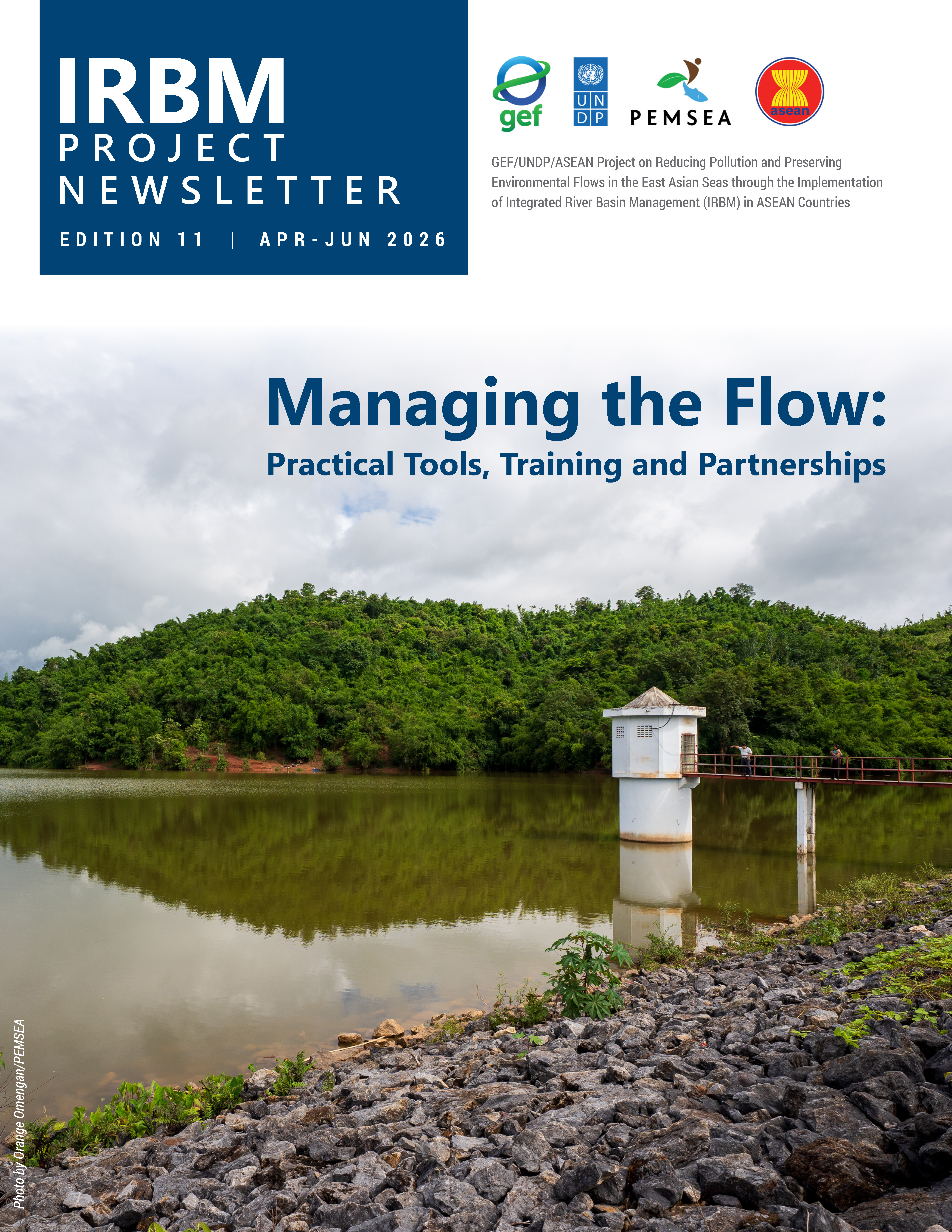
Integrated River Basin Management Project Newsletter - Edition 11
The second quarter of 2026 focused on technical capacity development, regional and global knowledge exchange, and basin-level implementation under the GEF/UNDP/ASEAN Integrated River Basin Management (IRBM) Project. Activities during the quarter included the Regional Training on the REWEFe Toolkit and Water–Energy–Food–Ecosystem (WEFE) Nexus Application; knowledge exchange on marine litter governance and Source-to-Sea cooperation; and the formalization of partnerships for Project implementation in the Kedah River Basin, Malaysia.
In April, representatives from the six ASEAN Member States participating in the Project took part in the hybrid Regional Training on the REWEFe Toolkit and WEFE Nexus Application, held in Manila, Philippines. Participants were introduced to the Project’s basin-level WEFE Nexus assessment and the REWEFe Toolkit comprising the User Manual and Guide. Through lectures, discussions, and hands-on exercises, they examined the governance and technical dimensions of applying the Toolkit, developed user-defined scenarios, and analyzed trade-offs and synergies across the WEFE nexus. The training also explored how scenario results can support cross-sector coordination and inform IRBM strategies and action plans, pilot project development, and stakeholder discussions at the river basin level.
Regional knowledge exchange continued in May through the PEMSEA Resource Facility’s participation in the International Summer Course on Marine Litter Management, Policy and Integrated Coastal Governance in the East Asian Seas Region, hosted by IPB University in Bogor, Indonesia. Ms. Nancy Bermas, Regional Project Manager of the IRBM Project, delivered a lecture on cross-country mapping of marine litter governance and management. She introduced PEMSEA’s Framework for Sustainable Development of Coastal and Marine Areas and presented the Manila Bay experience to illustrate how partnerships among governments, academic institutions, the private sector, development partners, civil society organizations, and communities can support coordinated responses to managing marine litter. She also discussed how the IRBM Project and the MOF/PEMSEA Marine Plastics Official Development Assistance (ODA) Project contribute to marine litter and plastic waste management.
Also in May, the Project shared its experience in applying the Source-to-Sea approach during the webinar, Source-to-Sea Cooperation: Practical Guidance for Implementation in Transboundary Basins, jointly organized by GEF IW:LEARN and the Secretariat of the UN Water Convention at UNECE. During the practitioner panel, Ms. Bermas explained how the IW:LEARN guidance has informed the Project from concept and project development through implementation, monitoring, evaluation, and learning. She highlighted its application in identifying priority flows and basin hotspots; conducting stakeholder mapping and governance baseline assessments; strengthening multisectoral and interagency river basin mechanisms; developing and implementing pilot projects to address the priority flows; and establishing monitoring, evaluation, and learning systems, including indicator-based State of River Basin Reports. She also emphasized the need for more on-the-ground examples showing how integrated river basin management, integrated coastal management, and marine protected area networks can be linked through the broader Sourceto- Sea framework.
In June, the Project officially launched implementation in the Kedah River Basin following the signing of a Memorandum of Agreement between the Universiti Sains Malaysia and the PEMSEA Resource Facility and a Memorandum of Understanding among the Department of Irrigation and Drainage Malaysia, the Kedah State Water Resources Board, and Universiti Sains Malaysia. The agreements formalized partnerships to strengthen the coordinating mechanism for IRBM implementation, undertake a baseline assessment of the river basin and associated coastal areas of Kedah State, and prepare a State of River Basin Report and IRBM Strategic Action Plan. The Project will also support the development and implementation of pilot projects addressing priority concerns, including flooding, declining water quality, and sedimentation.
This edition also features a closer look at the Project’s WEFE Nexus assessment, and the application of the REWEFe Toolkit supported by a User Manual and Guide. The feature explains how these resources contribute to understanding basin conditions, assessing future scenarios, and informing IRBM strategies, action plans, and potential interventions across the seven priority river basins.
PEMSEA eBulletin - June 2026
There's a quote that says, "Believe you can and you're halfway there." For PEMSEA, the month of June marks an exciting midpoint of growth and collaboration for sustainable coastal, ocean, and river basin governance across the East Asian Seas region.
Check out our key milestones this June:
Kedah River Basin, Malaysia: The GEF/UNDP/ASEAN Integrated River Basin Management (IRBM) Project officially launched implementation following a Memorandum of Agreement (MoA) signed between Universiti Sains Malaysia (USM) and the PEMSEA Resource Facility (PRF) on 16 June 2026.
PRICELESS Project Progress: The Project successfully held its Interim Inter-Agency Technical Working Group and Project Steering Committee meetings on 18–19 June to align strategic goals.
PEMSEA 2025 Annual Report: PEMSEA officially released its annual report, detailing a year of collective achievements, stronger partnerships, and high-impact initiatives in ocean governance.
New Alliance in Indonesia: On 22 June, ATSEA and Nusa Cendana University formalized a strategic partnership by signing a Memorandum of Understanding and Agreement in East Nusa Tenggara.
World Ocean Day in the Philippines: In Puerto Princesa City, Palawan, coastal communities joined a major coastal clean-up led by Project Zacchaeus, the Marine Environment Protector partner under the MOF/PEMSEA Marine Plastics ODA Project.
Regional Capacity Development: In Bangkok, PEMSEA Resource Facility Executive Director Ms. Aimee Gonzales spoke at the CAPFISH Summer Academy Southeast Asia, organized by the World Maritime University, RoKorea's Ministry of Oceans and Fisheries and Korea Maritime Institute emphasizing the critical need for innovation, inclusive governance, and regional cooperation to sustainably manage the region's fisheries.
PEMSEA eBulletin - May 2026
In Indonesia, read how IPB University convened the Summer Course on Marine Litter Management, Policy, and Integrated Coastal Governance. Discover how the PEMSEA Resource Facility supported the PEMSEA Network of Learning Centers (PNLC) as regional experts gathered in Bogor to train international students and early-career researchers. Ms. Nancy Bermas, Regional Project Manager of the GEF/UNDP/ASEAN Integrated River Basin Management Project, represented PRF and delivered a lecture on cross-country marine litter governance and management. She introduced PEMSEA’s Framework for Sustainable Development of Coastal and Marine Areas, highlighting how marine litter responses can align with global, regional, national, and local action plans, while using Manila Bay as a case study for multi-stakeholder collaboration. Ms. Bermas also shared how PRF’s IRBM Project and the MOF/PEMSEA Marine Plastics ODA Project on Reducing Marine Plastics are supporting regional efforts in marine litter and plastic waste management.
In the Philippines, discover how efforts to protect the Ticao-Burias Pass Protected Seascape (TBPPS) are translating into concrete local action as PEMSEA, the ASEAN Centre for Biodiversity (ACB), and DENR-BMB held a second major training workshop in Legazpi City on Integrated Coastal Management (ICM) and Marine Spatial Planning. In Thailand, read about the ASEAN ENMAPS project’s efforts to strengthen ICM and Marine Spatial Planning for marine protected area management through its training workshop.
PEMSEA eBulletin - April 2026
This month saw a region in motion, across coasts and river basins. In April, PEMSEA and its partners advanced blue carbon collaboration, strengthened coastal and river basin management, and pushed forward practical solutions across the region.
Read how PEMSEA’s non-country partners, the Korea Maritime Institute and the Korea Institute of Ocean Science and Technology, convened the 2026 Blue Carbon International Seminar, bringing together regional experts to connect science, policy, and emerging carbon markets.
In the Philippines, discover how efforts in the Ticao-Burias Pass Protected Seascape are supporting stronger marine protection and more coordinated local planning as
the ASEAN ENMAPS project held a training course where stakeholders were trained on integrated coastal management and marine spatial planning.
At the regional level, the GEF/UNDP/ASEAN Integrated River Basin Management Project continued to strengthen regional capacity through training on the Rapid Evaluation of the Water-Energy-Food-Ecosystems (REWEFe) and Water–Energy–Food–Ecosystem Nexus approaches. Read more on how participants are applying these tools to better understand trade-offs and support more integrated decision-making.
This month also covers first-quarter developments under the IRBM Project, including strengthened coordination, planning, and pilot actions in the Philippines. Discover how ongoing efforts in Cavite and Pampanga are translating strategies into practical solutions on the ground, while a featured story from Malaysia’s Kedah River Basin sheds light on the role of communities and women in sustaining river systems.
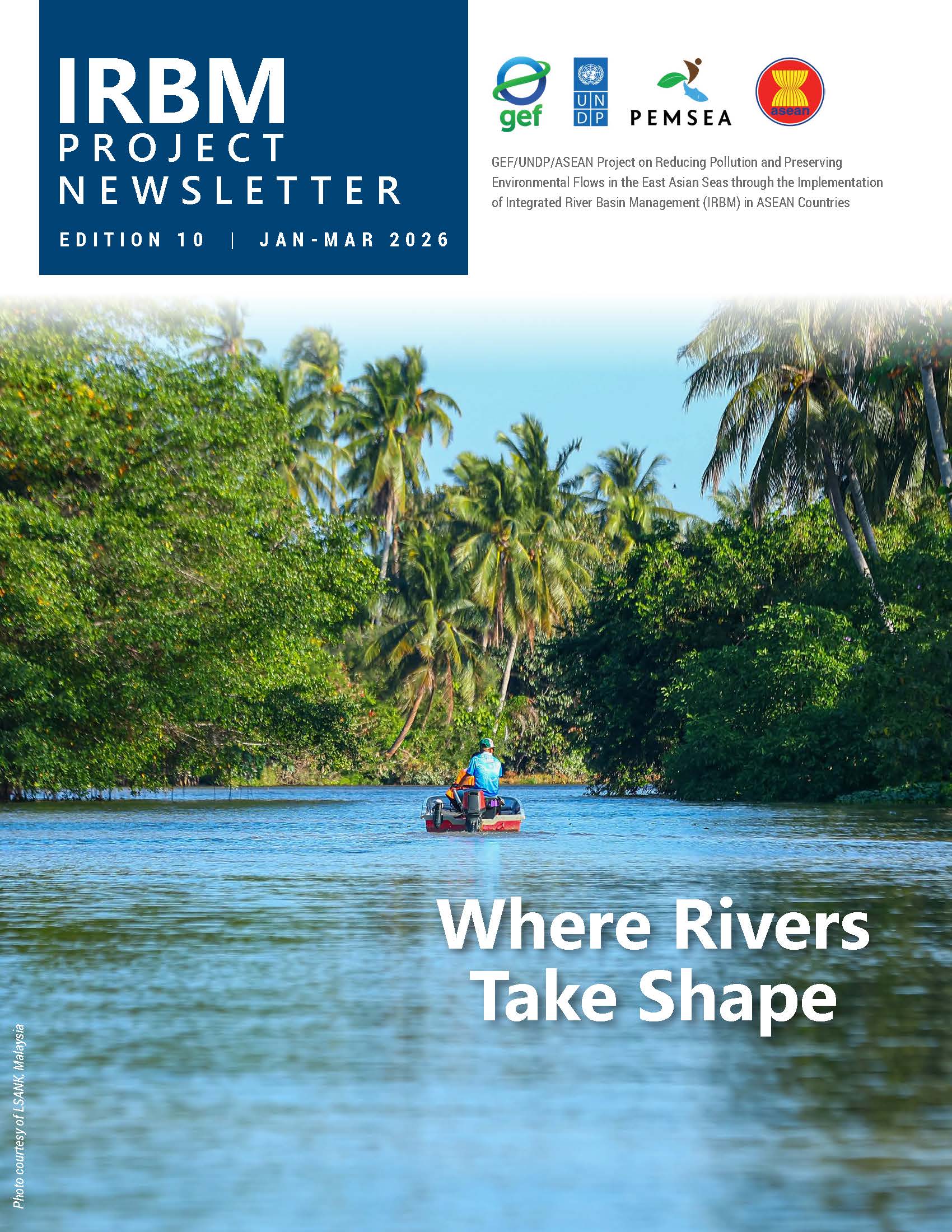
Integrated River Basin Management Project Newsletter - Edition 10
The first quarter of 2026 marked a period of strengthened coordination and forward planning for the GEF/UNDP/ASEAN Integrated River Basin Management (IRBM) Project, as participating ASEAN Member States and partners continued to build on institutional arrangements at national level and advance pilot interventions at basin level. These shared efforts were shaped by closer inter-agency collaboration, alignment of strategies, and a growing emphasis on translating plans into practical, site-based solutions.
In the Philippines, a key activity was the convening of the Organizational Meeting of the Project Steering Committee (PSC) in January, bringing together representatives from national government agencies to guide project implementation. The meeting clarified the governance structures, including the roles of the PSC, Inter-agency Technical Working Group, and Project Management Unit, while also reviewing and approving the 2026 workplan and budget. Discussions underscored the importance of harmonizing existing plans and programs across agencies to support integrated river basin and water resources management, particularly in the Project’s sites in Cavite and Pampanga.
At the basin level, coordination was further strengthened through a February meeting in Pampanga with the local government and the Department of Environment and Natural Resources for project implementation in Pasac–Guagua Watershed. The discussions provided updates on project implementation, revisited institutional arrangements, and identified priority directions for pilot project development. A notable shift emerged in the exploration of solutions, with stakeholders considering strategies to address solid waste—particularly food waste management—based on data showing that biodegradable waste comprises a significant share of total waste generated in the province. This reflects a more integrated and context-specific approach to address river basin challenges.
In March, the Project continued to support technical discussions on solid waste management through its participation in consultations in Da Nang, Viet Nam, where national and international partners examined priority concerns such as waste segregation, recycling systems, and the environmental impacts of landfill operations. Site visits further informed the identification of technical assistance needs and highlighted opportunities for innovation, including digital monitoring systems and alternative waste treatment solutions, where the Project could contribute.
In Cavite, Philippines, the Project participated in the review and updating of the 10-year Action Plan for the Imus-Ylang Ylang-Rio Grande Rivers (IYRR) Water Quality Management Area (WQMA), which brought together stakeholders to assess progress, identify gaps, and update strategies for improved river basin management. In support to the IYRR Action Plan and as part of pilot project development, the Project conducted the review of two feasibility studies commissioned by the DENR Environmental Management Bureau Region IV-A for the proposed wastewater and/or sewerage/septage treatment system in three river basins in Cavite Province and the Local Water Utilities Administration for the identification of concept designs for sanitation projects in the Municipality of Amadeo. The results were presented to the 1st Quarter 2026 Governing Board meeting of the IYRR WQMA. The IYYR WQMA Governing Board agreed to issue a resolution on the proposed establishment of septage treatment plant (STP) in the Municipality of Amadeo marking a key step toward advancing pilot project implementation under the IRBM Project.Collectively, the activities of the quarter reflect how these shared currents are beginning to take shape—grounded in strengthened partnerships and a clearer focus on practical solutions. This edition also features a profile story from Kedah River Basin in Malaysia, highlighting the experiences of women and communities whose livelihoods are closely tied to the river. Their stories underscore the vital role of women in sustaining water resources and shaping more inclusive and resilient approaches to river basin management.
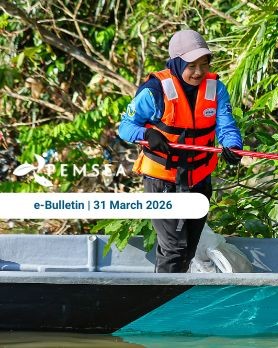
PEMSEA eBulletin - March 2026
Stronger partnerships and regional action defined March for PEMSEA. The month saw key meetings, workshops, and initiatives that advanced collaboration, knowledge sharing, and sustainable management across the East Asian Seas.
Driving decisions at the 35th Executive Committee Meeting. On 31 March, the PEMSEA Executive Committee convened at the PEMSEA Resource Facility in Quezon City, Philippines, to review milestones, including the appointment of a new PRF Executive Director, the 2025 audited statements and Accomplishment Report, and the proposed 2026–2027 Workplan and Budget. Discussions tackled regional priorities from youth engagement and marine protected areas to blue carbon and renewed engagement with Malaysia, Thailand, and Brunei.
Accelerating blue carbon action at the PNLC Workshop. From 24 to 27 March, PNLC members met for From Knowledge to Action: Scaling Blue Carbon Initiatives in the East Asian Region and the 5th General Assembly. Co‑sponsored by the University of Hawaiʻi and the University of the Philippines Marine Science Institute, the workshop highlighted the climate, biodiversity, and resilience benefits of mangroves, seagrasses, and tidal flats while fostering collaboration and knowledge exchange across the region.
On 17-19 March, the GEF/UNDP/ASEAN IRBM Project joined stakeholders to update the 10‑year Action Plan for the Imus–Ylang Ylang–Rio Grande and Cañas‑Maalimango Rivers WQMAs in Cavite, Philippines. Participants reviewed progress, identified gaps, and refined strategies to tackle pollution and promote sustainable river basin management.