REGIONAL MARINE STRATEGY
The Sustainable Development Strategy for the Seas of East Asia is the regional marine strategy jointly agreed by PEMSEA country and non country partners. It is a package of applicable principles, relevant existing regional and international action programmes, agreements, and instruments, as well as implementation approaches, for achieving sustainable development of the Seas of East Asia. It offers a regional framework for the interested countries and other stakeholders to implement, in an integrated or holistic manner, the commitments they have already made, without assuming new legal obligations. The SDS-SEA embodies the shared vision of the countries and other stakeholders for the Seas of East Asia, and the ways by which they will achieve that shared vision.
SDS-SEA 2003
The first Sustainable Development Strategy for Seas of East Asia (SDS-SEA) was adopted by 12 governments in December 2003, namely: Brunei Darussalam; Cambodia; China; DPR Korea; Indonesia; Japan; Malaysia; Philippines; RO Korea; Singapore; Thailand; and Vietnam, with the signing of the Putrajaya Declaration of Regional Cooperation for Sustainable Development of the Seas of East Asia. In 2006, the governments of Lao PDR and Timor-Leste also adopted the SDS-SEA.
As originally drafted, the SDS-SEA incorporated relevant international conventions, existing regional and international action programs, agreements and instruments, as well as applicable principles and implementation approaches for achieving sustainable development of the Seas of East Asia. It did not create a new set of obligations but rather complemented existing ones.
SDS-SEA 2015
 In 2015, SDS-SEA was updated to address the changing context in ocean governance, in light of new or amended international and regional agreements, including the UNFCCC, the Sendai Framework for Disaster Risk Reduction, the Rio+20 “The Future We Want”, and the UN Sustainable Development Goals (SDGs).
The SDS-SEA 2015 provides a framework for policy and program development and implementation at the regional, national and local levels for achieving the goals and targets set by these various global instruments. The SDS-SEA also provides a platform for cooperation among PEMSEA Partners and collaborators, as well as other stakeholders.
SDS-SEA Strategies, Objectives and Action Programs
The SDS-SEA 2015 contains seven strategies, and related objectives and action programs for sustainable development of coasts and oceans.
The DEVELOP strategy concerns new and emerging development policies and investment strategies of countries of the region and opportunities for development of the “blue economy”. The objectives and action programs in the Develop strategy emphasize the use of integrated coastal management (ICM) as an effective management framework for achieving economic improvements in the marine sector while securing social and ecological well being.
The SUSTAIN and PRESERVE strategies address issues related to biodiversity protection, conservation and rehabilitation, enhancement of freshwater and marine water quality and equitable and sustainable fisheries…essential aspects for sustainable development of the coastal and ocean economy.
The PROTECT strategy addresses the brown agenda…pollution reduction and waste management from land- and sea-based sources, while the IMPLEMENT strategy focuses on compliance with relevant international conventions and agreements, and the execution of related obligations at the regional, national and local levels.
The ADAPT strategy focuses on climate change adaptation and disaster risk reduction and management by strengthening capacities and measures for preparing, adapting and responding to natural and man-made hazards.
The COMMUNICATE strategy is an overarching commitment to information and knowledge-sharing and the mobilization of governments, civil society, the business community, scientists and universities, and the region’s youth for sustainable development of the coastal and marine environment.
SDS-SEA Implementation Plan (2018-2022)
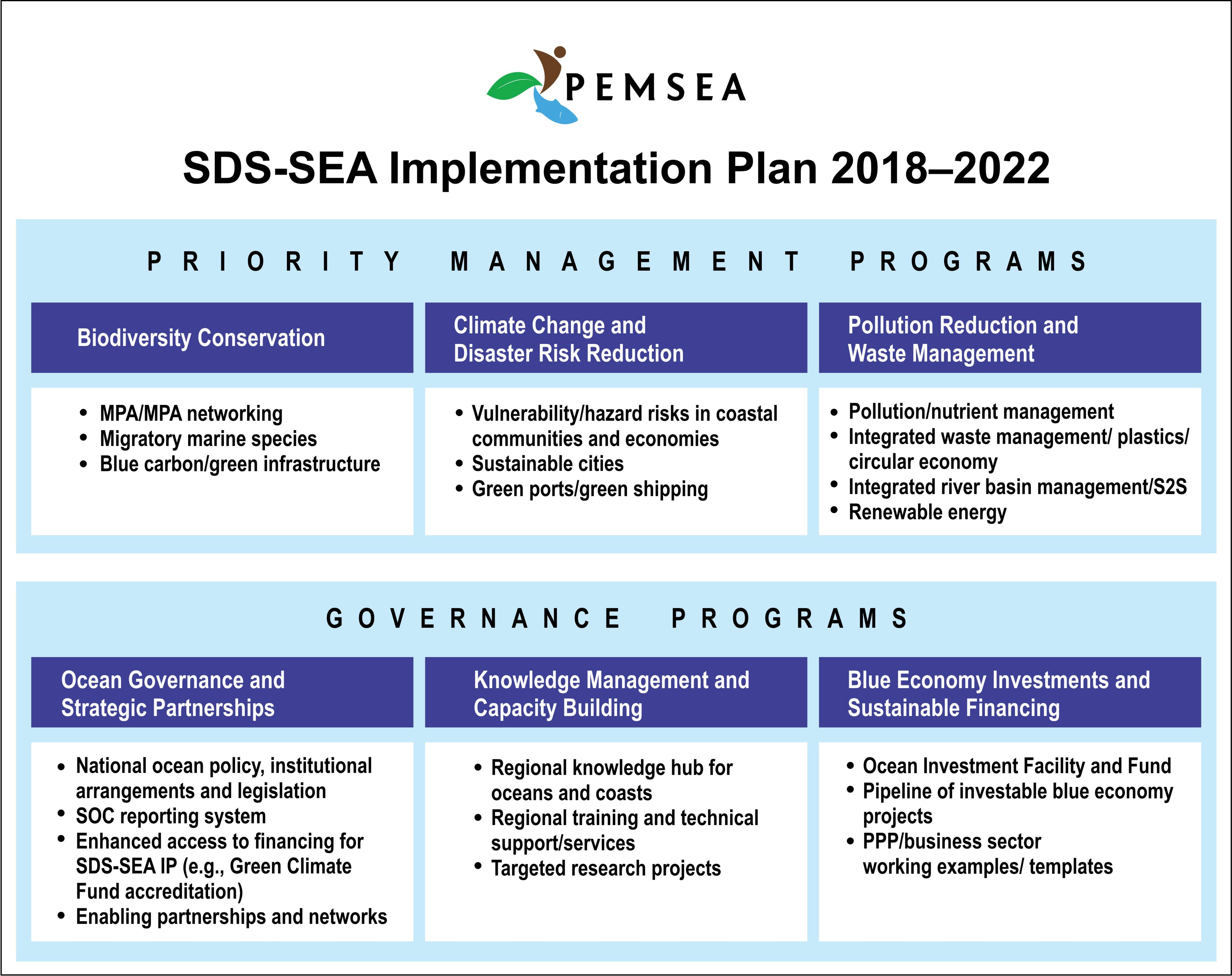
 The SDS-SEA IP 2018-2022 is composed of 3 Priority Management Programs and 3 Governance Programs. The Priority Management Programs include: a) Biodiversity Conservation and Management; b) Climate Change and Disaster Risk Reduction and Management; and c) Pollution Reduction and Waste Management. The cross-cutting Governance Programs include: a) Ocean Governance and Strategic Partnerships; b) Knowledge Management and Capacity Development; and c) Blue Economy Investment and Sustainable Financing.
Each Priority Management and Governance program includes 3 parts: (1) an introductory section providing an overview of the priority issue area/program, the region’s current situation and major efforts undertaken, and remaining gaps and challenges; (2) a summary of key international and regional commitments directly relevant to respective priority program; and (3) a matrix of the overall objective of the priority program, expected outcomes to 2022, indicators of benefit/impact, and targeted actions and schedule to which PEMSEA Country and Non-Country Partners may indicate/identify relevant activities of possible collaboration/initiatives (ongoing/planned) that would help contribute to achieving the region’s targets.
As a living document, the PEMSEA Partners in coordination with the PRF Secretariat would continue to collaboratively identify priorities, outputs and indicative actions that align with the SDS-SEA IP 2018-2022, and jointly implement initiatives/activities that would be identified.
To ensure regular monitoring of progress and gaps, progress/achievements of Partners and collaborating organizations will be highlighted during national and regional ocean events, as well as documented via PEMSEA’s Annual Report and the triennial State of Oceans and Coasts (SOC) Report.
SDS-SEA Implementation Plan (2023-2027)
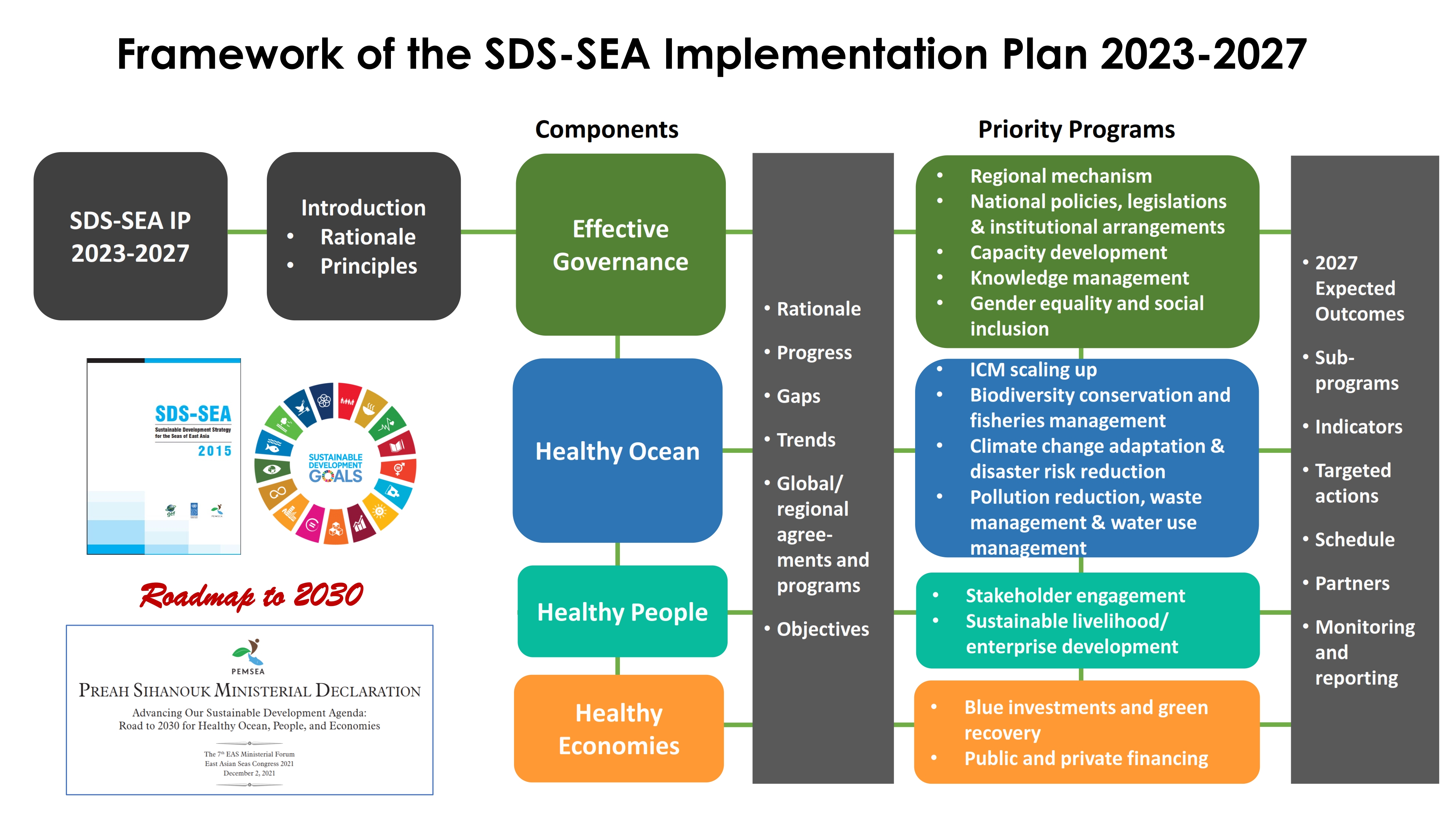
 The SDS-SEA IP 2023-2027 was developed through a consultative and participatory process, involving the Advisory and Technical Working Group and selected representatives from Country and Non-Country Partners and PNLC. Partners set new targets by taking stock of the SDS-SEA accomplishments for the period 2018-2022 and guided by the post 2020 initiatives and actions to accelerate sustainable solutions in line with the SDGs at global, regional and national levels, the COVID-19 post pandemic recovery measures, and more importantly, the direction provided in the Preah Sihanouk Ministerial Declaration for stepping up actions on the road to 2030.
SDS-SEA Implementation Plan (2023-2030)
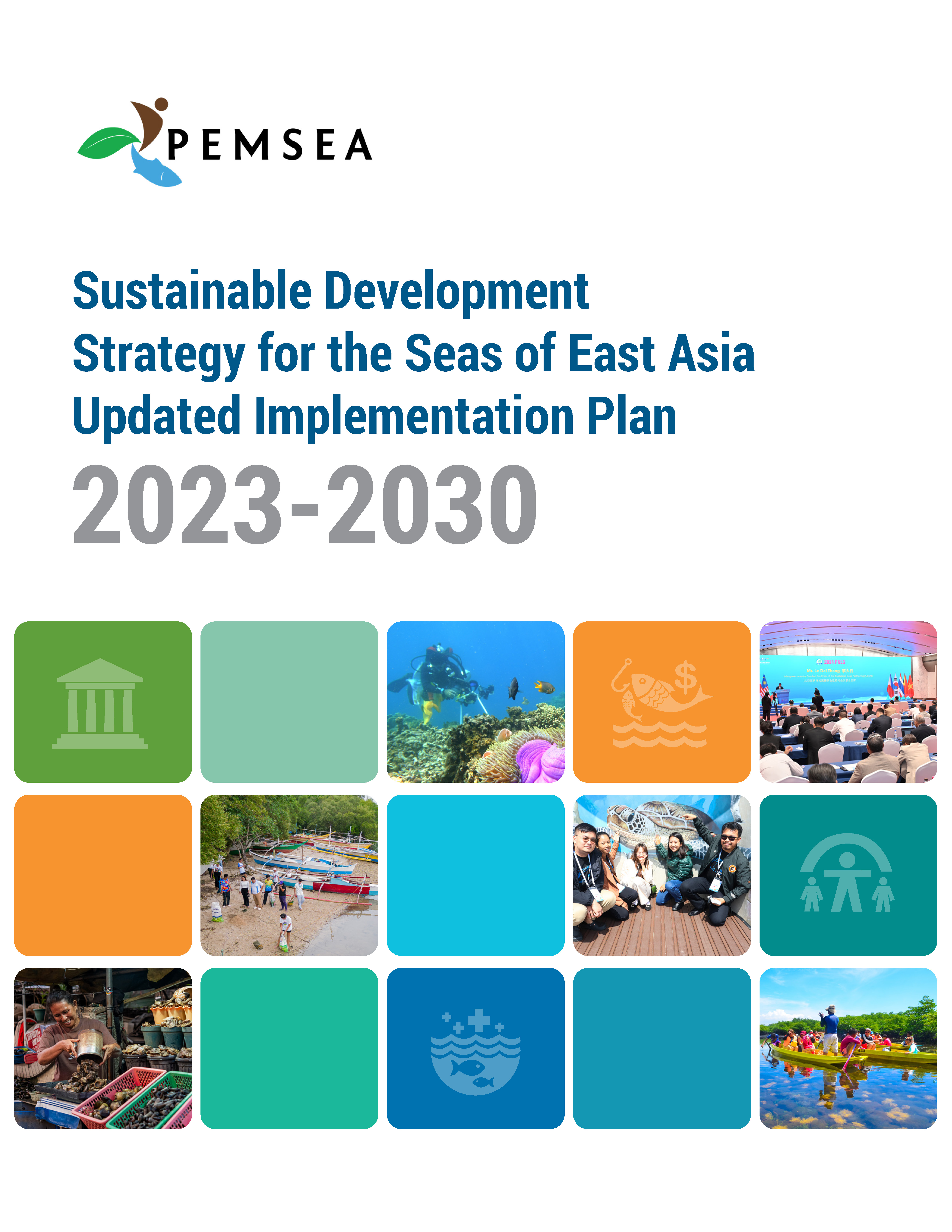
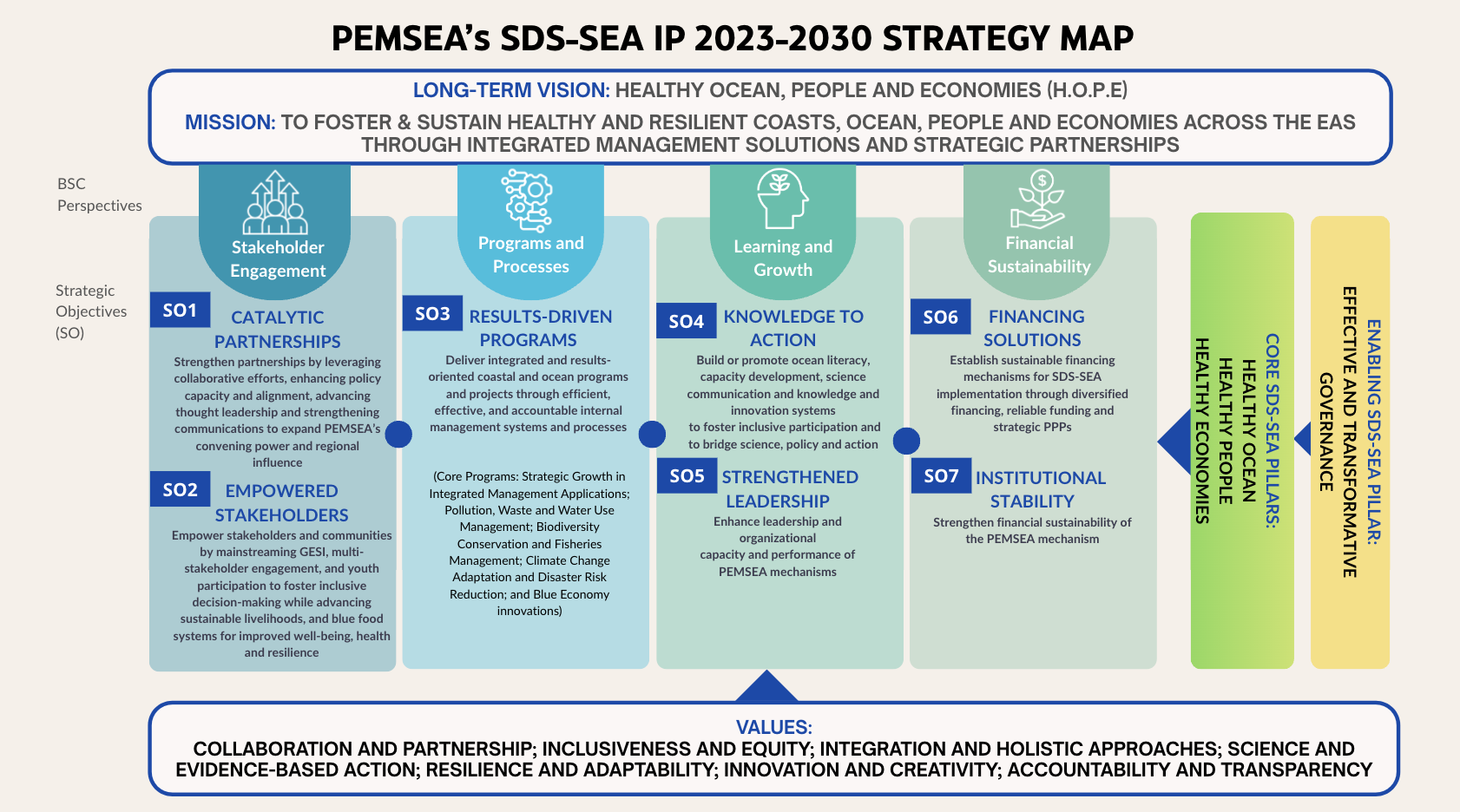
The Sustainable Development Strategy for the Seas of East Asia (SDS-SEA) Updated Implementation Plan 2023-2030 was drafted to extend the previous plan's timeframe to 2030, ensuring the continued relevance, effectiveness, and long-term sustainability of PEMSEA’s initiatives while enhancing organizational effectiveness, financial sustainability, and operational efficiency. The updating process was driven by several supporting efforts, including the mid-term progress review of the SDS-SEA IP 2023-2027, a review of status and trends in coastal and ocean governance, results from PEMSEA’s Organizational Capacity Assessment (OCA), and consultations with PEMSEA Country and Non-Country Partners. To bolster results-based management, the plan introduces a Strategy Map and Balanced Scorecard (BSC) as high-level tools for leadership to provide overall strategic direction across four key perspectives: Stakeholder Engagement, Programs and Processes, Learning and Growth, and Financial Sustainability. These high-level tools are supported by a detailed Strategic Results Framework (SRF), which guides operational implementation and performance tracking, with results from the SRF feeding upward to systematically inform the BSC and Strategy Map. Overall, the updated plan is focused on seven Strategic Objectives that are periodically monitored via a two-tiered system with support from various partners and networks, ensuring the plan remains fit for purpose and serves as a guide for adaptive management.